
Most people become rich the slow way: they earn a decent income, keep a big chunk of it, invest that chunk for a long time and avoid the mistakes that wipe out wealth. That’s the whole formula. It sounds simple because it is. The hard part is sticking to it for 20 years while everyone around you is buying new cars.
This guide breaks the formula into steps you can act on, with the actual math behind each one.
First, Decide What “Rich” Means to You
Rich isn’t a salary. Plenty of people earning $200,000 a year are broke because they spend all of it. Rich is about net worth: everything you own minus everything you owe.
Write down a number. Maybe it’s $1 million. Maybe it’s enough that your investments could cover your bills without a job. A clear target turns “I want to be rich someday” into a plan you can measure every year.
If your real goal is never having to work again, our guide on how to become financially independent goes deeper into that version of rich.
The Three Methods That Build Wealth
Every path to wealth uses the same three methods:
- Earn more. Raise the amount of money coming in.
- Keep more. Raise the share of that money you don’t spend.
- Grow it. Put what you keep into things that increase in value.
Most people focus on only one. Someone with a high income and no savings stays stuck. Someone who saves hard but keeps cash under the mattress loses ground to inflation. You need all three working together.
Step 1: Grow Your Income on Purpose
Cutting expenses has a floor. You can only cut your grocery bill so far. Your income doesn’t have that limit.
The fastest income jumps usually come from:
- Skills that are hard to replace. Trades like electrical work, nursing, software, sales and specialized certifications tend to pay more because fewer people can do them.
- Switching employers. Moving to a new company often comes with a bigger raise than waiting for one where you are.
- Asking. A lot of people never negotiate their first salary or their raises. A short, prepared conversation can be worth thousands a year.
- A side income that uses what you already know. Weekend freelance work, consulting or a small business can add a second stream of money.
Every extra dollar you earn is only useful if you keep some of it, which brings us to the method most people ignore.
Step 2: Keep a High Share of What You Earn
Your savings rate is the percentage of your income you don’t spend. It matters more than almost anything else, because it decides how much money you have to invest.
A person earning $60,000 who saves 20% puts away $12,000 a year. A person earning $100,000 who saves 5% puts away $5,000. The lower earner is building wealth more than twice as fast.
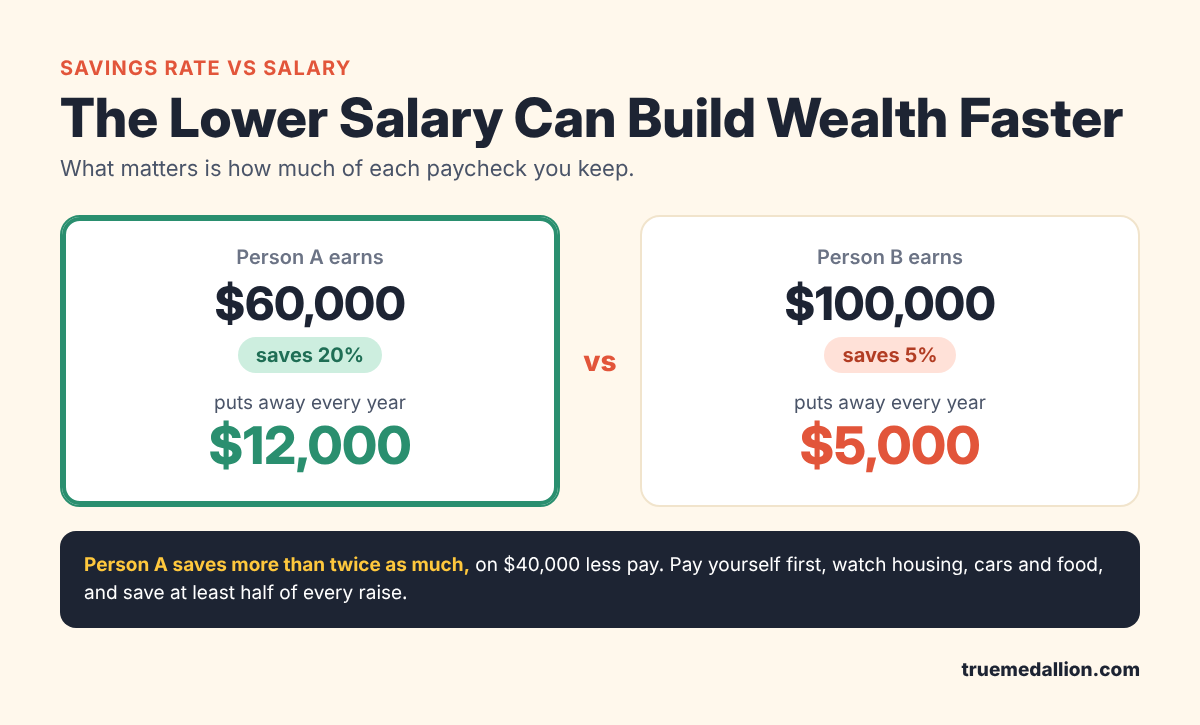
To push your savings rate up without feeling miserable:
- Pay yourself first. Set up an automatic transfer to savings or investments the day your paycheck lands, so the money is gone before you can spend it.
- Watch the big three. Housing, cars, and food eat most budgets. One smart decision on rent or a car saves more than a hundred skipped coffees.
- Fight lifestyle creep. When you get a raise, save at least half of it. You’ll still feel richer, and your savings rate climbs every year.
Step 3: Invest Early and Let Time Do the Work
Saving alone won’t make you rich. Investing is where the real growth happens, because your money earns returns, and those returns earn returns of their own. That’s compounding.
Here’s a hypothetical example. Say you invest $300 a month and earn an average return of 7% a year. That rate is only an assumption for illustration. Real returns go up and down, and nothing is guaranteed. You can test your own numbers with the SEC’s free compound interest calculator.
| Years investing | Total you put in | Approximate value at 7% |
|---|---|---|
| 20 years | $72,000 | about $156,000 |
| 30 years | $108,000 | about $366,000 |
| 40 years | $144,000 | about $787,000 |
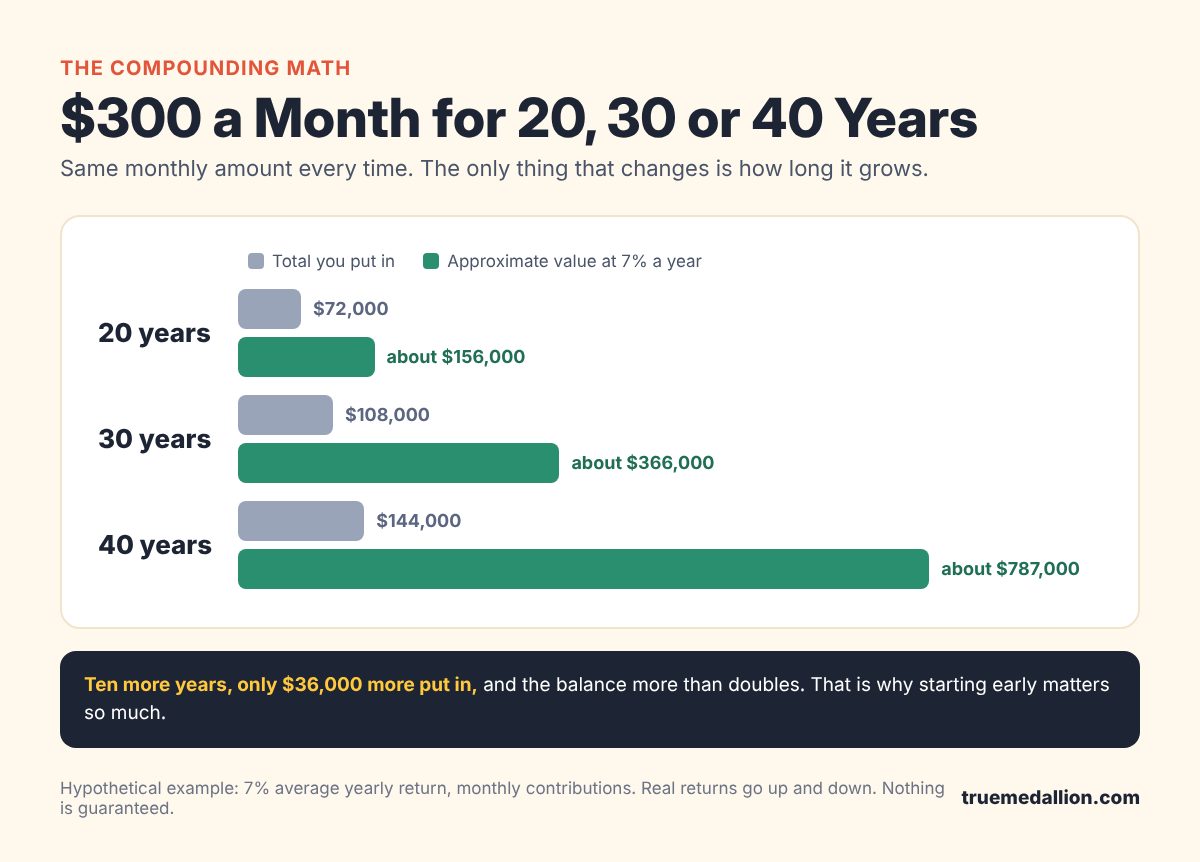
Look at the jump between 30 and 40 years. You only put in $36,000 more, but the balance more than doubles. That’s why starting at 22 instead of 32 matters so much.
For most people, the simplest way to start is with accounts that already exist for this purpose:
- An employer retirement plan like a 401(k). If your company matches contributions, take the full match first. It’s the closest thing to free money you’ll ever see.
- An IRA. A Roth or traditional IRA lets you invest on your own with tax benefits. The yearly contribution limit changes, so check the current IRS limit.
- Low-cost index funds. Instead of picking individual stocks, an index fund buys a small piece of hundreds of companies at once. Fees stay low, and you don’t need to be an expert.
If you’re starting with very little, our list of small investments that make money is a good place to look next.
Step 4: Own Things That Grow
Most self-made wealthy people own something: shares of companies, real estate, or a business of their own. A paycheck pays you for your time. Ownership pays you even when you’re not working.
You don’t need to buy a building or start a company tomorrow. Owning index funds already makes you a part-owner of real businesses. As your savings grow, you can decide whether rental property or a business of your own fits your life and your tolerance for risk.
Step 5: Avoid the Things That Keep People Broke
You can do everything right on the first four steps and still go backward if you fall into these traps:
High-interest debt. Credit card interest rates are often 20% or more. Carrying a balance at that rate erases investment gains faster than you can earn them. Pay it off before you invest beyond your employer match.
Get-rich-quick schemes. Anything that promises guaranteed huge returns, asks you to recruit friends, or pressures you to “act now” is a red flag. Real wealth is boring and slow on purpose.
Panic selling. Markets drop sometimes, and occasionally they drop hard. People who sell in a panic lock in their losses. People who keep investing through the dips usually come out ahead over long periods.
No emergency fund. Without a cash cushion of a few months of expenses, one car repair or job loss forces you onto credit cards or into selling investments at a bad time.
Step 6: Give It Time
Here’s the part nobody likes to hear: for most people, becoming rich takes decades. The people who seem to get rich overnight are usually lottery winners, early employees at the right startup, or folks who quietly put in 15 years before anyone noticed.
That’s good news, though. You don’t need to be lucky, a genius or born into money. You need a decent income, a high savings rate, steady investing and patience. Those are all things you control.
For the mindset side of the journey, read our guide on how to become a millionaire from nothing.
How to Become Rich: FAQ
Legally and with good odds, there isn’t a fast way. The quickest realistic path is growing your income sharply, saving a large share of it and investing the difference for many years. Anything promising wealth in weeks is usually a scam.
Yes. Many people with average incomes build large net worths by saving 15% to 20% of their pay, investing it in low-cost funds and avoiding high-interest debt for 30 years or more.
It depends on your time frame and your returns. Using the hypothetical 7% example above, saving $300 a month for 40 years gets you close to $800,000. Saving more, or starting earlier, gets you past $1 million.
This article is for general education, not personal financial advice. Talk to a licensed financial professional about your own situation.