
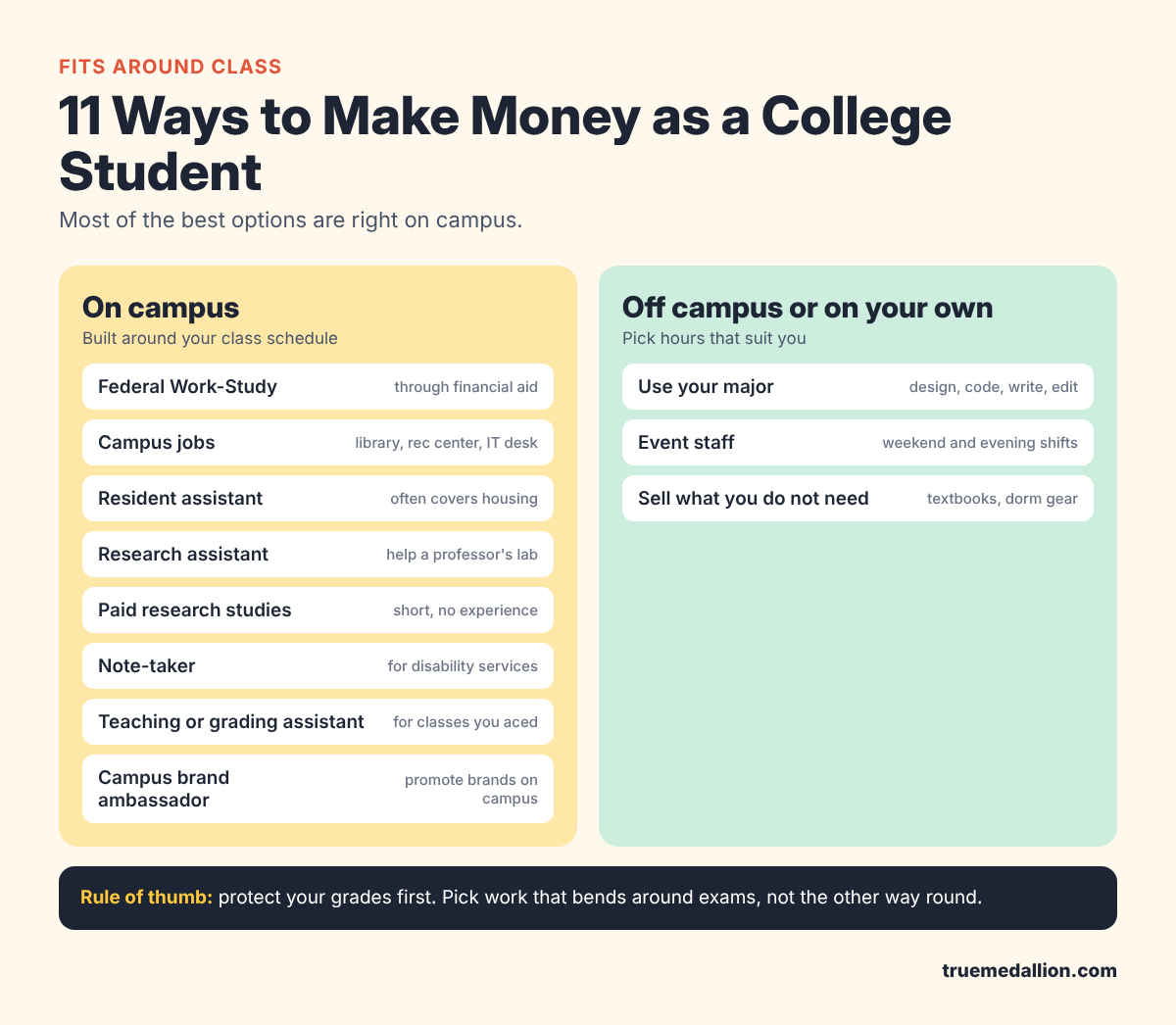
The best ways to make money in college are the ones that bend around your class schedule: campus jobs, work-study, paid research and flexible gigs you can pick up between exams. Off-campus jobs with rigid shifts can work too, but they tend to collide with midterms.
Here are 11 ways to earn money as a college student, starting with the options most students overlook.
1. Federal Work-Study
Federal Work-Study is a financial aid program that gives eligible students part-time jobs, usually on campus. The money is earned like a regular paycheck, but the program is designed so your hours work around your classes.
You’re considered for work-study when you fill out the FAFSA. If it shows up in your financial aid offer, contact your school’s financial aid or student employment office to find open positions. Many students never use the work-study they’re offered, so it’s worth checking.
2. Campus Jobs
Even without work-study, colleges hire students for dozens of roles: library desk, rec center front desk, dining hall, IT help desk, admissions tours, mailroom and more.
Campus employers understand finals week. Some jobs, like a quiet library desk or a building front desk, even let you study during slow periods. Check your school’s student job board early in the semester, because the best spots fill fast.
3. Resident Assistant (RA)
RAs live in the dorms and help first-year students settle in, enforce building rules and plan events. In return, many schools cover part or all of your housing, and some add a meal plan or a stipend.
Since housing is one of the biggest college costs, an RA position can be worth more than a typical part-time job. Applications usually open in the fall or winter for the next school year.
4. Research Assistant
Professors often hire students to help with their research: running experiments, entering data, reviewing articles or managing lab equipment. Some positions are paid, and others offer course credit.
Beyond the paycheck, research experience looks great on applications for grad school, med school or competitive jobs. Ask professors in your major during office hours, and check your department’s website for postings.
5. Paid Research Studies
Psychology, economics, business and medical departments regularly run studies that pay participants in cash or gift cards. A typical study might take 30 minutes to an hour of answering questions or playing a computer task.
Look for a “research participation” or “subject pool” page on your school’s website, or flyers around the psychology building. You won’t get rich, but it’s easy money between classes.
6. Note-Taker for Disability Services
Many schools pay students to share clear class notes with classmates who have accommodations through the disability services office. If you already take good notes, you’re getting paid for something you do anyway.
Ask your school’s disability or accessibility office whether they hire paid note-takers. Some schools pay per class, per semester or in the form of a stipend.
7. Teaching or Grading Assistant
Large intro courses often hire undergraduates who aced the class to help grade homework, run review sessions or staff lab sections. It’s a good fit if you did well in a class and liked it.
Ask the professor who taught you, or check the department office. These jobs strengthen your understanding of the subject and give you a strong reference for later.
8. Campus Brand Ambassador
Brands that want to reach college students, from food delivery apps to clothing companies, hire students to promote them on campus. Tasks might include handing out samples, running social media posts or hosting small events.
Pay structures vary. Some pay hourly, others pay per event or per sign-up. Read the terms carefully and make sure the brand is legitimate before you agree to anything.
9. Use Your Major for Side Work
Whatever you’re studying probably has a paid use. Graphic design students can design logos for local businesses. Computer science students can build simple websites. Accounting students can help small businesses with bookkeeping. Language students can translate documents.
Start small with people you know, like a friend’s family business or a campus club, and build a portfolio. That portfolio becomes your best résumé when you graduate.
10. Event Staff on Weekends
Stadiums, arenas, concert venues and convention centers hire students for weekend and evening events. Ushering, ticket scanning, concessions and setup crews are common roles.
Shifts are usually built around game nights and concerts, which fit well with a weekday class schedule. If your college has a big sports program, the athletic department often hires event staff directly.
11. Sell What You Don’t Need
Every semester ends with students throwing away things other students would happily buy. Sell your used textbooks back, list your mini fridge and desk chair before move-out, and grab free furniture other students leave behind to resell in August.
Your school’s student marketplace groups and Facebook Marketplace are full of buyers at the start of each semester. Just time it right: people buy dorm gear in August and January, not in May.
How Many Hours Should a College Student Work?
Many students find that working about 10 to 15 hours a week is manageable without hurting their grades. Past 20 hours, it gets harder to keep up, especially during exam weeks. Protect your study time first. A lower GPA can cost you more in lost scholarships and job offers than you’ll earn on extra shifts.
A few habits make juggling work and school easier: block your class and study hours before you pick up shifts, choose jobs that let you swap shifts easily, and use slow moments at work to review notes. Our time management tips for students can help too.
If you need a bigger chunk of money quickly, say for a security deposit or a laptop, see our guide on how to make $1,000 fast.
Not in college yet? These 12 jobs for 18-year-olds open up the day you turn 18.
How to Make Money as a College Student: FAQ
Paid research studies and campus desk jobs are among the easiest. Research studies take little time and need no experience, and many front desk jobs let you study when it’s quiet.
Work-study earnings are reported on the FAFSA, but they’re generally treated differently from regular wages when your aid is calculated. Ask your financial aid office how it applies to your situation.
Usually only in limited ways. Students on F-1 visas can generally work on campus with hour limits during the school year, while off-campus work requires specific authorization. Always check with your school’s international student office first.